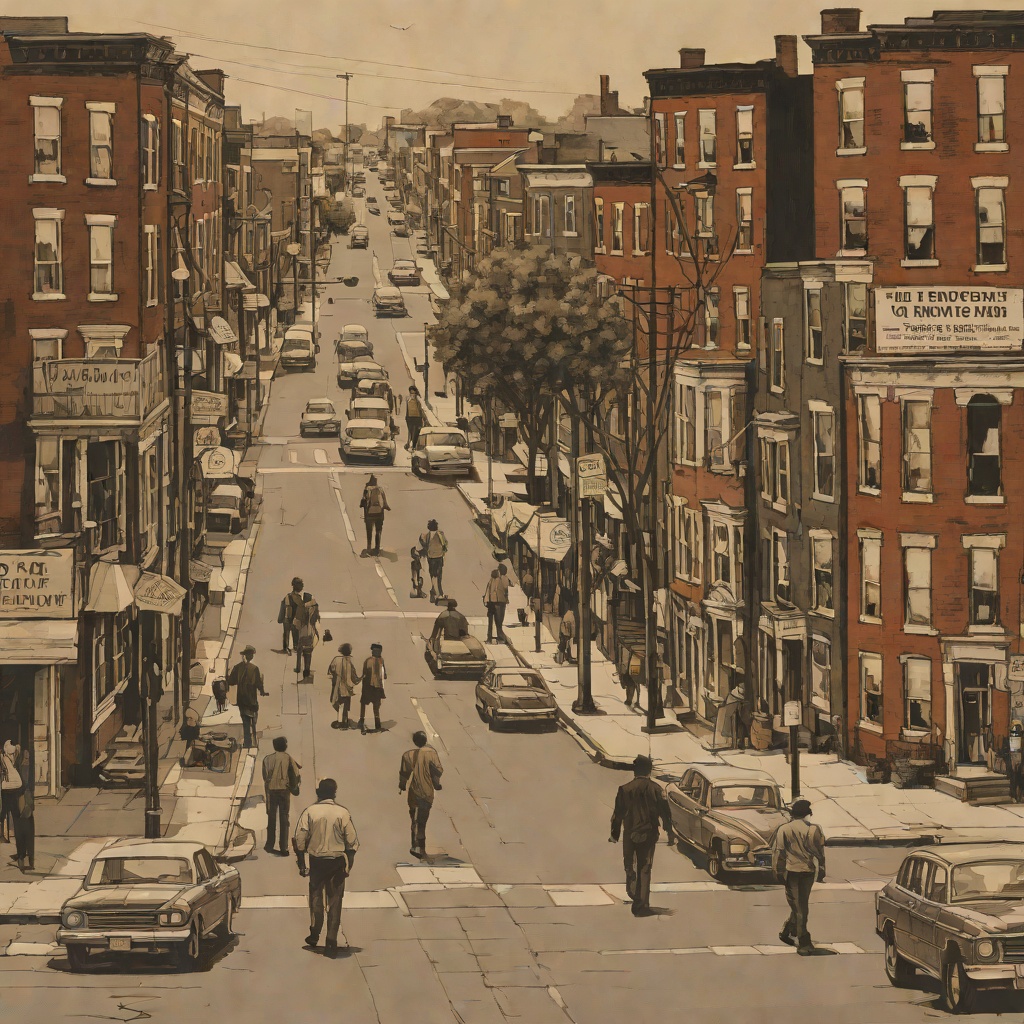
Baltimore
Lady in the LakeBaltimore in the mid-1960s is more than the backdrop of this novel; it is the force that determines who is seen, who is missed, and who is allowed to matter. It is a city of stark racial and economic partitions, where a woman's value is measured by the man at her side, where a Negro woman can disappear without consequence, and where a white woman can walk into a newsroom and reinvent herself. The city's parks, temples, department stores, and segregated police force are not just locations but active participants in the story of Maddie Schwartz, Cleo Sherwood, and the men who orbit them. From the temple steps where Milton Schwartz buries his father to the newsroom of The Baltimore Star, from the changing neighborhoods to the courthouse steps, Baltimore is the stage on which the novel's dramas of race, class, gender, and justice are played out.
A City of Boundaries and Observation
Baltimore is first introduced through the eyes of Cleo Sherwood, who recalls a chance encounter with Maddie Schwartz in 1964, late fall, on the steps of a temple a block from Druid Hill Park. Cleo, a poor Negro woman slipping away from her crowded apartment with a book in her purse, observes Maddie's plain black pillbox hat, her black coat with fur at the throat and cuffs, her shellacked hair, and her shiny black shoes. The encounter is a study in contrasts: Cleo's coat is too thin, pilled and limp, saggy at the hem, her legs bare, while Maddie's stockings almost shimmer. For Cleo, this moment crystallizes a survival strategy: to get a man with money, she would need to look as if she didn't need money. The city's social hierarchy is written in its clothing, its neighborhoods, and its institutions, and Cleo reads it with the precision of a woman who has learned that her green eyes and straight nose are her only currency. She notes that Maddie's husband, Milton, now looked exactly like his father, a man Cleo remembered with some affection from buying candy in his store as a little girl, and she guesses from the way people gathered around him on the temple steps that Milton was a big shot.
The city's geography reinforces these boundaries. Maddie, before her transformation, had avoided downtown Baltimore, venturing there only for the occasional symphony performance or dinner at Tio Pepe's or the Prime Rib, thinking it dirty and dangerous. But working at The Star, with its proximity to the raucous bars along the harbor and the grand department stores on Howard Street, she feels herself falling in love—not with the city so much as the possibility of a new start, at an age when she had thought her life would basically be over. The city offers her a second act, even as it denies one to Cleo. Maddie's own childhood arithmetic—born in 1928, she would be twenty-two at midcentury, seventy-two at the dawn of the twenty-first—had assumed adulthood was static, but Baltimore proves her wrong. The house she and Milton bought in Pikesville, their second, might as well have been a mausoleum, an elegant, well-appointed mausoleum, and the city's vitality becomes the antidote to that living death.
The Segregated City and Its Institutions
The novel is unsparing in its depiction of Baltimore's institutional racism. Ferdie Platt, the Negro detective who becomes Maddie's lover, explains the limits of his world: the department is segregated, Negro cops walk patrols or do undercover in narcotics, they can't use cars, and he doesn't even have a radio, just a call-box key. When Maddie is hurt that the men at The Star don't treat Cleo's disappearance as a big deal, Ferdie laughs at her: "Because she's a Negro, Maddie. That's why it wasn't a big deal when she went missing." The city's white institutions—the police, the newspapers, the restaurants that won't hire Negro waitresses—are built on a hierarchy that renders Black lives invisible. Even a white man like Don Heath, when asked why he wouldn't attend a funeral, answers simply, "She's colored," as if that settles the matter. Maddie, who insists she is not naive, is nonetheless hurt, having thought her anger over the callousness of the men at the Star was a kind of tribute to her lover, never quite grasping that the indifference to Cleo's fate is not about her marital status but about race.
The city's changing neighborhoods are a constant theme. Maddie knows the signs that indicate a neighborhood is about to tip from white to black: the "Under Contract" and "SOLD" signs swinging beneath the original "For Sale" signs are covert code for "Get out now." She can't understand why whites in the city don't want to live next to black people, but they don't, and the mass hysteria over the issue means that values plummet rapidly. She reflects that the Christian neighborhoods hadn't wanted the Jews, and still didn't, really. The newest location of EZ Kleeners, the dry cleaners owned by Ezekiel Taylor, is next to a beauty shop in a neighborhood just beginning to change, and Maddie observes that the white women walking into Pietro's to get their hair cut and styled would be happy for the convenience of a dry cleaners in the neighborhood, but they wouldn't want Mr. Taylor as their neighbor. The city's racial geography is a series of tipping points, and everyone—white and Black—is acutely aware of which side of the line they stand on.
A City in Political Turmoil
The political life of Baltimore and Maryland in 1966 forms a crucial backdrop. The novel accurately represents the 1966 Maryland gubernatorial race, down to the weather on the day after the primary, a detail gleaned from Time magazine. The Republican candidate, Spiro Agnew, is a presence throughout; at a dinner at the Schwartz home, the guests laugh about his most recent blunder, a speech at Gettysburg where he was clearly confused about which side had prevailed on that battlefield. A newsroom colleague, the acerbic Edna Sperry, reveals that she has been contacted by Agnew, who offered her the press secretary's job, and that she countered by asking for a cabinet post, preferably Commerce, then reached out to Congressman Sickles, the likely Democratic nominee, to tell him that Agnew wants her. "Come November, I'm in a win-win," she reflects, a cynical calculation that speaks to the city's political culture.
The primary falls two days before Rosh Hashanah, and Maddie volunteers to take results, typing vote tallies in the city legislative districts. When she enters the numbers for the senate seat in the Fourth District, she sees that a newcomer, Clarence Mitchell III, is the top vote-getter, with Verda Welcome second, and Ezekiel Taylor a distant fourth. The election results bring a sensation sweeping through the newsroom, a surprise in the results that catches even jaded Edna off guard. For Maddie, the political moment is intertwined with her personal disillusionment. She reflects on how silly she had been to think that any of this had anything to do with Cleo. In hindsight, she sees the world for what it is: men are entitled to have their girls on the side, as long as they are discreet, and some men feel entitled to kill the women who do not return their affections. Cleo Sherwood did not matter enough; she could not have swayed this election. She had never mattered at all. Ezekiel Taylor's reputation is intact, his campaign underwritten by Shell Gordon's dirty money, while Cleo's father's crazed, desperate act outside the courthouse—shooting into a crowd and grazing a young police officer—has drawn more attention than his daughter's murder. The city's politics, like its police force and its newspapers, are structured to preserve the status quo, and Cleo's death is just another casualty of that structure.
The City as Memory and Legacy
The novel's frame extends beyond 1966, showing how Baltimore and its institutions remember—and forget—the people who passed through them. In October 1985, at The Woman's Club of Roland Park, Maddie Schwartz is introduced as a speaker who has worked at The Beacon since 1966, where her career began with a harrowing first-person account of her near death at the hands of Angela Corwin. The introduction recaps the city's legal history: Angela Corwin was convicted of the first-degree murder of Tessie Fine, a young Jewish girl killed in the tropical fish store where Corwin's son worked, and Stephen Corwin was given the death penalty, later changed to life after a US Supreme Court decision struck down most of the nation's death penalty laws in 1972. Maddie's career trajectory—general assignment reporter, city hall and legislature coverage, then the Living section as a reporter of human-interest stories and finally a columnist, a Pulitzer finalist in feature writing in 1979—is a story of the city's own evolution, from the segregated newsroom of the 1960s to the more established, if still imperfect, institution of the 1980s.
The author's note grounds the novel's Baltimore in historical fact. The book's small details are largely factual, except when they're not. The two murders at its center are inspired by two cases from 1969, and the gubernatorial race in Maryland in 1966 is represented accurately. Two real-life people—Violet Wilson Whyte, the first Negro cop, a woman, and Paul Blair, the Orioles center fielder—"speak" in these pages, their voices approximated from interviews and videos. The author acknowledges that she could never establish that Whyte had appeared on To Tell the Truth, but heeds the age-old advice from The Man Who Shot Liberty Valance: print the legend. Baltimore, in this novel, is a city of both fact and legend, a place where the historical record and the stories people tell about themselves are constantly in tension. The city is also a site of personal memory: the narrator of the opening section, who saw Maddie once on the temple steps, reflects on how small Baltimore can be, how paths cross and recross. The city's intimacy is both its charm and its danger, a place where a woman can be seen and tallied up in a single glance, and where a life can be dismissed just as quickly.